Its not often you see business associations support budget requests by State agencies, especially when its Ohio EPA.  However, as a result of Senate actions with would cap Ohio EPA’s spending authority business groups have sent a strong letter of support to the Ohio Legislature requesting the caps be removed. (Ohio Chamber and Ohio Manufacturer’s Letter Re: Ohio EPA’s Budget).

When Ohio EPA introduced their budget proposal they requested an increase in solid waste and construction & demolition debris tipping fees in order to maintain the current staff.  Under the proposal municipal waste dumping fees would go from $4.75 per ton from the current $3.50 per ton.  C&D fees would have seen the largest jump, going from $1.70 per ton to $4.40 per ton.Ohio EPA argued the fee increases were necessary to offset increasing costs to maintain as well as adjust for a decline in the amount of waste being disposed in Ohio’s landfills. 

The fees became lost in a sea of other fee increase proposed by Governor Ted Strickland designed to help balance Ohio’s beleaguered budget.  More so than in budget battles past, the fees were likened to tax increases and many (including Ohio EPA’s request) were stripped from the budget.

In a recent Springfield News-Sun article, State Sen. Keith Faber, R-Celina, articulated "fees are hidden taxes" argument.  Here is his quote from the article:

“The EPA is a fee-based entity. They should have to tighten their belts like everybody else. Not just ask for more fees,” Faber said.

Ohio EPA requested that the Legislature restore their spending authority and re-establish the $1.00 fee increase in municipal solid waste fees.  Now this issue will play out in a contentious Conference Committee this weekend.  The Business Group’s letter strongly supports the restoration of spending authority, but is silent on any fee increase. 

However, the Senate went one dramatic step beyond stripping out proposed fee increases, it placed a cap on allowable expenditures from existing fees.  In other words, Ohio EPA would be prohibited above the cap from spending money it had already collected from existing fees.

In response, Ohio EPA issued an analysis that if the fees remain out and the caps in place it would be forced to eliminate 200 positions (cut or not fill vacant positions).  Understanding the budget debate needed to be linked to Ohio’s ailing economy, the Agency said many of the eliminated positions would likely be in permitting sections which could slow down economic development in the State. Here is the analysis provided by Ohio EPA of the potential staff cuts. 

Division of Air Pollution Control Staff Cuts

Division of Surface Water Staff Cuts

Unfortunately, this issue is a relatively small issue in terms of the $2.4 billion dollar budget gap that the Conference Committee must fill.  Governor Strickland recently proposed very controversial spending cuts to many State programs.  How Ohio EPA will fair in this type of difficult budget climate remains to be seen. 

Ohio EPA is my former employer and I still have the scars from past budget battles.  From my time at the Agency I am a strong believer in the fact the Agency needs to maintain staff to keep up with an ever increasing workload. A workload that many outside the Agency walls don’t see or don’t fully appreciate. I am crossing my fingers that the Legislature will devote a small amount of time to resolve this issue and will do the right thing.

(Photo: J.Stephen Conn/flickr)

On Monday, the Cleveland Plain Dealer had a picture (above the fold) taken 40 years ago of a man dipping his hand in the Cuyahoga River and having it covered in oil and muck.  In the background is the River that was an oil and waste cesspool, devoid of any life.  Everything was primed for a follow up story in the Plain Dealer today talking about the 40th Anniversary of the famous fire on the Cuyahoga River and show casing Cleveland’s massive environmental achievement in cleaning up the River, then in stepped U.S. EPA….

As discussed in detail in the prior postEnding 40 Years of Cleveland Jokes: A River’s Recovery, the 40 year clean up of the Cuyahoga River has resulted in an unbelievable achievement.  For most of the forty miles upstream of the navigation channel, the River is teeming with life, including:

  • more than 40 species of fish
  • ten times the amount of fish per kilometer

To show this amazing progress, Ohio EPA and the Cuyahoga RAP submitted a formal request supported with reams of data to U.S. EPA’s Great Lakes National Program Office (GLNPO) asking that huge portions of 40 mile stretch be "delisted" or, in other words, taken off the list of the most polluted rivers in the country.  Yesterday, at the Year of the River celebration, local and state politicians, environmental groups and government representatives gathered to receive the good news- U.S. EPA had granted the request.  Only to find out that GLNPO couldn’t see past the bureaucratic red tape and essentially denied the request (GLNPO Letter).  Here was is on the Plain Dealer’s web page today regarding the Year of the River event:

Fantastic job, Northeast Ohio, really. But even after an incredible 40-year turnaround from fire to fish-friendly, still not enough has been done to bring the Cuyahoga River into environmental compliance.

That was essentially the message the U.S. EPA delivered Monday to officials and environmentalists gathered for 40th anniversary of the last fire on the industrial waterway.

GLNPO did not deny the request because the disagreed with the data that showed a return of fish and aquatic life to the River.  In fact, they sent a letter saying they agreed with the data.  Instead, GLNPO said they just didn’t want to delist portions of the River due to internal difficulties in tracking the data.   So all they could send was a letter saying "nice job" and the data shows recovery, but we can’t formally recognize anything.

While this may not seem like a big distinction, the fact is the media was all set to portray the story in an extremely positive light.  I talked with a couple of local reporters and press people covering the event.  Some had glowing coverage written and prepared to be released only to rewrite the stories at the last minute once everyone figured out what U.S. EPA had actually done.  What could have been a event garnering regional if not national attention, ended with local news stories discussing the bureaucratic U.S. EPA. 

Having working on Great Lakes issues for a number of years, I am wise enough to know that progress must be documented when pouring millions into improving the Lakes.  U.S. EPA’s Great Lakes National Program Office should be trumpeting these successes to gain momentum, not deflating the balloon. 

Let’s hope that a lesson can be learned and U.S. EPA will sit down and realize they need to take a fresh look at establishing milestones and formally recognizing achievements.  Otherwise we will have a difficult time ever convincing the Country spending hundreds of millions on the Great Lakes is a wise investment.

(Photo:tangywolf/everystockphoto.com)

Yesterday, U.S. EPA announced a proposed rulemaking to formally recognize Cleveland and nearby counties as achieving the 1997 8-hour ozone standard (.085ppb).  As discussed in a previous post, this is very good news for Northeast Ohio businesses in any of the following counties: Ashtabula, Cuyahoga, Geauga, Lake, Lorain, Medina, Portage, and Summit.  U.S. EPA is taking comments on the proposed action until July 13th.

Three years ago the best experts thought it was impossible for Northeast Ohio to achieve the ozone standard by the 2010 deadline.  As a result, draconian measures were suggested by U.S. EPA, including "bumping up" to the next higher non-attainment classification "serious."  Such an action would have made economic growth in the area much more difficult.  It would also have increased environmental compliance costs for area businesses. 

The chart to the left shows the various federal pollution reduction programs that are mandated based upon non-attainment classification.  The chart shows the higher the classification of non-attainment the more federal mandates that will apply.

Northeast Ohio has been at a distinct disadvantage relative to other areas of the state due to its ozone non-attainment status.  It is the only "moderate" non-attainment are in the State.  This results in increased compliance costs for area businesses and also placed restrictions on economic growth not applicable to the rest of the State.  These disadvantages would have been magnified if the Cleveland-Akron-Lorain area was forced to have "bumped up" to serious non-attainment.

Once U.S. EPA finalizes the redesignation to attainment, these disadvantage disappear.  Cleveland-Akron-Lorain will be able to compete equally for new business growth opportunities.  All of this should be really good news for business and the citizens in Northeast Ohio.

The Plain Dealer failed to capture this fact in its coverage of the U.S. EPA ozone announcement.  Instead it focused on the temporary nature of the Cleveland-Akron-Lorain attainment status.  U.S. EPA has adopted a stricter ozone standard (.075ppb) which will likely be applied in 2010.  Current air monitoring shows Northeast Ohio around .084 ppb for ozone which means the same eight counties will once again be deemed "non-attainment" for ozone.   

While it is true the attainment status is temporary, concentrating only on this aspect of the story misses the broader picture.  If the area failed to achieve the 1997 ozone standard it would have faced more regulation and impediments to growth.  Now it appears unlikely that Cleveland-Akron-Lorain will receive a higher non-attainment classification than other major metropolitan areas in the State.  This means it will be able to compete equally with Columbus and Cincinnati for new jobs in the future even if it is once again considered "non-attainment."

The temporary attainment status may present a short window of opportunity for area businesses.  If a business was looking to expand its facility or construct a new facility that would be considered  a "major source" of air pollution, it may be able to obtain requisite permits easier than previously.  But businesses will have to be quick to take advantage if such a window presents itself.  U.S. EPA is set to make formal designation under the new .075 ppb ozone standard in 2010.  At most this means businesses could have a year to act.

June 22nd will mark the 40 year anniversary of the famous 1969 fire on the Cuyahoga River.  A picture of the fire in Time magazine was credited with bringing national focus to water pollution in the United States.  Here is a quote from a recent Cleveland Plain Dealer Article on the notorious fire:

"The fire did contribute a huge amount to the new environmental movement and it put the issue in front of everyone else, too," said Jonathan Adler, environmental historian and law professor at Case Western Reserve University. "Water pollution became a tangible, vivid thing — like it had never been on a national level. "There was a sense of crisis at that point. It was: Oh, my God — rivers are catching on fire.’ "

In 1972, Congress passed the Clean Water Act whose stated goal is to make waterways across the country "fishable and swimmable."  Forty years ago, achieving the goal of the Clean Water Act seemed impossible for rivers like the Cuyahoga. 

The River was virtually dead from the release of industrial wastes and untreated sewage along with intensive urban and industrial development.  I remember talking with some of the original employees of the Ohio EPA who described the rivers like the Cuyahgoa and the Mahoning were virtually boiling from steel mills and other industrial sources that did not cool their water prior to discharging into the River.      

Flash forward to 2009, we are about to celebrate the anniversary of the fire by marking a significant achievement  in its recovery.  The Cuyahoga River Remedial Action Plan along with Ohio EPA has submitted a request U.S. EPA to take official action by removing most of the river  from list of the most polluted rivers in the Great Lakes (delisting request).  As the Chairman of the Cuyahoga RAP, I was lucky enough to sign the letter submitting the official request to U.S. EPA. 

The area of recovery stretches from Akron to 50 miles down the River to its navigation channel.  A once dead River is now teaming with life.  The River so notorious for its fire is now become a favorite for steelhead fly fishing. 

Perhaps no aspect of the recovery tells the story better then the return of fish to the River. The chart to the left is part of the delisting request to U.S. EPA.  It is a compilation of years of data collection from the River.  The horizontal axis is the miles of the River.  The vertical axis is the number of fish species. 

1969 is represented by the nearly flat purple line across the bottom indicatng virtually no life in the River except for its upper most reaches.  The green line across the top is 2008 which shows between 15 to 25 species living in the River.  (The dip in the green line is the Route 83 dam which shows how dams can have dramatic impacts on water quality)

What an amazing recovery.  From dead in 1969 to a River that has a wide variety of species and healthy fish in 2008.  Here are some more details on the return of fish to the River:

  • In 1984 the relative number of fish caught per kilometer was 53. In 2008 the relative number was 657 fish per kilometer. 
  • Total species in 1984 was 28, compared to 43 in 2008 with ¼ fewer sites. 
  • In 1984 there was only 1 individual of a sensitive species. In 2008 there were 10 sensitive species comprising 1412 individuals (31% of the total catch). 
  • In 1984 there were only 8 bass caught. In 2008 there were 221 bass caught, with the dominant species being Smallmouth Basin. 
  • In 1984 there was only 1 darter individual collected. In 2008 there were 5 species of darters (228 individuals). 
  • In 1984 there were no redhorse species (sensitive) in the entire reach. In 2008 there were 3 species (96 individuals). 

What are the reasons behind the miraculous recovery of the Crooked River?  It took a combination of major investment, successful environmental regulation and protecting the sensitive corridors along its banks. 

  1. Major investment by private industry and municipal wastewater treatment facilities- the North East Ohio Regional Sewer District and Akron’s wastewater system have invested billions of dollar upgrading treatment.  Industry along the river has invested millions in new treatment wastewater treatment technology and improved business practices.
  2. Environmental regulation- Often maligned, the recovery demonstrates that regulation can be effective.  The Clean Water Act brought permits to all the major discharges to the River.  Overtime, as technology improved, the permits ratcheted down how much pollution dischargers could put into the river.
  3. The Cuyahoga Valley National Park and Cleveland Metroparks- Maintaining natural vegetation along the banks of rivers and streams has major benefits to water quality.  This vegetation operates as filters-absorbing non-point pollution before  it can impact waterways.  It also provide habitat for important bugs and critters that breathe life into streams.  The Cuyahoga Valley National Park protects 33,000 acres along the banks of the Cuyahoga River.  The park system operates as a massive riparian corridor along the River. 

Local news coverage of the remarkable comeback of the burning River has been good.  The Cleveland Plain Dealer has a series dedicated to the Year of the River.  But this deserves to be a national story.  So often the Midwest and Cleveland seem to be the epicenter of bad news- from a down economy to the housing crisis.  Don’t get me started on the sports teams. 

What once brought Cleveland into the national spotlight for all the wrong reason should now bring attention for the rights ones.  How great would it be to see Time Magazine revisit the River forty years later!  Maybe with a picture of some fly fishing on the River.  Another reason to highlight the recovery nationally, the Obama Administration has requested $475 million in funding for the Great Lakes. What a better poster child for showing investment in the Great Lakes can work than the Cuyahoga.

If you want to do your part to help the river, you can purchase t-shirts and mugs embossed with the four fish graphic at the beginning of this post.   Money raised will be used to support on-going efforts to restore the River.  If you happen to be in the Cleveland area come down to the River on the 22nd and celebrate this amazing story or re-birth.  You can get details form of the events planned from the Cuyahoga RAP’s website.


Since this is about the 1 year anniversary since I launched my blog, I thought it was nice to see a fellow blogger has included Ohio Environmental Law Blog as one of the fifty best environmental blogs available.  Check out the list of the 50 Best Environmental Law Blogs as compiled by E-justice.  Its a good list of other sites, many of which I read to keep up on the latest happenings. 
Also, thanks to my readers.  It has been a great year.   I have had well over 17,000 different people visit my site.  Many have returned many times.  I have had interviews with Newsweek, Inside EPA, trade publications, and local newspapers.  Earlier this year I even had a clerk for a federal judge ask for more information about one of my posts.   Most of all I have enjoyed providing my viewpoints and updating readers on developments in this exciting area.

There has been certainly no shortage of developments in the environmental and green fields.  With serious consideration of climate change legislation it is an exciting time for all who work in the field.  I’m always open to suggestions and your comments, so keep them coming. 

Thanks again…

(Photo: mshades/everystockphoto.com)

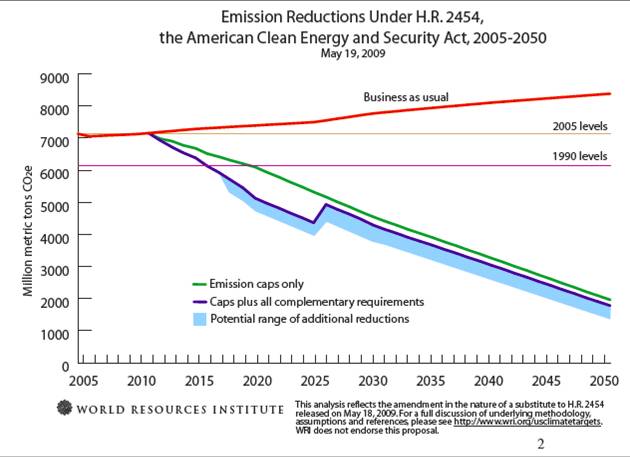
The American Clean Energy and Security (ACES) Act of 2009 has cleared one hurdle through passage by the House Energy and Commerce Committee.  The bill now makes its way through at least two more House Committees before a floor vote will occur.  The House leadership has set an aggressive time frame for passage, Speaker Pelosi has said the remaining Committees must finish their work by June 19th.  This leads to the possibility of a  floor vote no later than the end of the month or early July. 

(World Resources Institute Graph on anticipated reductions from ACES- click on chart to enlarge)

While the ACES legislation appears to be moving quickly, major issues remain with the structure of the legislation as well as its timing.  The Senate does not have a companion bill and many speculate the Senate will be unwilling to simply take of the Waxman-Markey Bill.  Therefore, a tremendous amount of uncertainty remains as to the approach the Senate will use to take up climate change legislation.

What are the possible issues that will be debated in House Committee hearings and in the Senate?  Some will include the following:

  1. 5 year Phase Out of Allocations-  The mark up version of the ACES legislation saw a significant compromise  on the auction v. allocation debate.  Whereas, the President had proposed a 100% auction, ACES only calls for a 35% auction in the early years.  However, the bill still proposes an aggressive phase out of allocations for the energy sector. (See Pew Chart to Left that show dramatic shift downward in allocations during 2025-2030 – click on chart to enlarge) While it may seem like a long way off, in a five year period stretching from 2025-2030 the legislation phases out allocations moving to 90% auction of allowances.  Industry is concerned that this aggressive phase out period will lead to price spikes in utility costs.
  2. 2020 Emission CAP– Emission reductions called for in the initial years was reduced.  The first major milestone of the cap is seen as 2020.  The original bill called for a 20% reduction below 2005 levels.  The mark up reduced that to a 17% reduction by 2020.  However, some forget that President Obama had called for a 14% reduction by 2020.  There are many industry representatives who believe the early reductions still need to be softened to make the bill workable.  There may be a renewed push to bring the 2020 cap down to the 14% reduction.
  3. 2012 Start Date-  The Legislation calls for a modest 3% reduction in 2012.  However, some in industry believe 2012 is too early and does not give adequate lead time to prepare for the cap.  During an EMA presentation, Bruce Braine, Vice President of AEP, commented that the 2012 time frame may force switching to natural gas that will result in price spikes in the first year the cap is effective.
  4. International Offsets-  In the face of widespread controversy regarding the European Trading Scheme (ETS) use of offsets, the bill includes many limitations on use of international offsets.  Beginning in 2018, there is an automatic 20% discount in the value of international offsets.  The bill limits use of international offsets to those categories of projects that have received approval by U.S. EPA.  In addition, there is a sector limitation on use.  Sectors in various countries will be identified where offsets are deemed appropriate (factors includes GDP and receiving equal treatment in project host country).  Finally, there must a an applicable bi-national or multi-national treaty in effect with the Country. Industry is concerned that these requirements will reduce the availability of international offsets thereby driving up the cost of compliance.
  5. Environmentalist Perspective-  The consensus among the environmental community appears to be that the "watering down" of the ACES legislation was necessary to secure passage.  Therefore, even with the dramatic shift away from auction of allowances, most groups still support the Legislation.  The key issue from an environmentalist perspective is the proverbial "line in the sand" to prevent additional changes, including concessions to industry on the issues mentioned above in the Senate.
  6. Ideology v. Realism-  Republicans who have uniformly opposed the carbon cap and trade legislation.  Even though industry support for the Legislation has grown, many Republicans have had success describing the Legislation as a large tax increase during a down economy.  This message plays well even with some Democrats from the Midwest and Southern States that face the greatest impacts from climate change legislation.  The "realism" aspect is that regulation of greenhouse gases appears inevitable.  A market based solution is clearly a better alternative to command and control regulation under the Clean Air Act.  However, are some members of Congress in denial that regulation is inevitable?

Obviously, ACES went through a dramatic transformation to gain passage from the House Energy and Commerce Committee.  The overwhelming majority of changes were to address industry concerns with the Legislation.  The most important changes were the shift away from auction of allowances and reduced reduction targets in the early years of the cap. 

Additional battles may be looming in the House over the issues identified above and others.  However, the most important battle ground remains the U.S. Senate where the future is less certain.


On May 18, 2009 the Clean Ohio Council finalized new policies that will govern future rounds of the Clean Ohio Revitalization Fund (CORF).  A major change has been incorporated into the policies that will impact developers, consultants and contractors who work on Clean Ohio projects.  For the first time the Council has included conflict of interest prohibitions. 

The conflict of interest prohibitions are directed primarily at consultants who have previously acted as both developer and environmental consultant on a project.  Contractors are also prohibited from taking any interest in the development if they want to received Clean Ohio funds to perform work on the project. 

Another important prohibition applies to consultants and prohibits participation as both consultant for the developer and a company who caused or contributed contamination at the property.  This has occurred at projects because it appeared to create continuity on the project.   Some public entities saw it as a positive to continue to involve the consultant who has the most knowledge about the challenges presented by contamination at the property.

If you are involved in Clean Ohio projects, this new provision carries important implications that could shape future involvement at brownfield redevelopment projects.  It will also be important to monitor your partners in a project because a conflict of interest could hold up the whole project. 

Here are the new provisions:

10.02 Entities paid for with Clean Ohio Revitalization Fund grant dollars on a funded property must avoid conflicts of interest. A conflict of interest occurs when an individual or organization involved in the cleanup project has an interest that might compromise their ability to execute the project in a manner consistent with the intentions of the Clean Ohio Revitalization Fund program. A conflict of interest may exist even if no proven illegal act results from it, and will include an appearance of impropriety that undermines confidence in the individuals or organizations involved in the project. To avoid a conflict of interest and ensure that proper checks and balances exist, the following restrictions are placed on funded properties:
    • The Certified Professional may not act as the developer or an investor in  the development on the funded project.
     • The selected environmental consulting firm or their employees may not act as the developer or an investor in the development on the funded project.
     • The selected contractor or subcontractors may not act as the developer or an investor in the development on the funded project.
      • The selected environmental consulting firm and the contractor or subcontractor for the funded project may not be the same firm or related firms.
     • The selected environmental consulting firm may not be engaged in concurrent service agreements for the grantee and the party that caused and contributed to the contamination on the funded project.

(Photo: Patriarca12/everystockphoto.com)

As an indication the New Source Review (NSR) enforcement actions are alive and well, today an Indiana federal court has ordered the shut down of units that triggered NSR and failed to install controls.  In addition, the Court required Cinergy to surrender allowances to compensate for "irreparable harm" caused by the operation of the units in violation of the Clean Air Act

The Federal District Court in Indiana issued its decision in the remedy phase of the New Source Review (NSR) enforcement action against Cinergy Corporation’s Beckjord, Ohio plant.  A jury trial was held in May of 2008 to determine whether certain projects triggered NSR.  The jury found that four projects performed at the facility "a reasonable power plant owner or operator would have expected a new increase of 40 tons of SO2 and/or NOx "(NSR major modification trigger levels).  Following the jury’s verdict, the Court moved into the remedy stage to determine what relief to grant the plaintiffs for the violations.

The Courts decision is an interesting exercise of looking its crystal ball.  Based on calculations of emissions and modeling, the Court projected environmental harm caused by failure to comply with NSR. 

To determine harm, the Court first determined the type of pollution controls that would have been installed had Cinergy complied with NSR requirements (BACT/LAER).  Those controls established the baseline emissions that should have been emitted since the projects were completed.  All emissions above the baseline were considered  "excess emissions" that resulted in environmental harm and potential health impacts.

It was pretty evident which direction the Court was heading when it included the following statement in its order:

With respect to SO2 emissions, Dr. Fox testified that the annual excess emissions of SO2 is approximately 23,000 tons…Putting this into perspective, this rate is approximately equivalent to the amount of SO2 emitted by 324,000 heavy-duty diesel trucks, which is the total number of trucks registered in Indiana, Ohio and Kentucky.

The analysis of environmental harm and potential health impacts was very similar to the exercise undertaken by the North Carolina Court in the nuisance claims against coal fired power plants (see post, "Nuisance Finding Gives Downwind States New Ammo in Long Cross-Border Pollution War").  Here is what the Court examined to gage harm caused by "excess emissions":

  • How did the SO2 and Nox emission impact pm 2.5 and ozone attainment
  • What were mercury emission impacts
  • Potential health impacts from fine particle pollution
  • Damage to the environment from acid rain

After finding irreparable harm from these impacts the Court ordered:

  1. Shut down of three units by Sept. 2009
  2. Until Sept. 2009, the three units must be run so as not to exceed baseline levels that are based BACT/LAER controls
  3. Permanently surrender SO2 allowances in an amount equal to total SO2 emissions from May 22, 2008 until September 30, 2009

For those who though the NSR consent decrees carried with them pretty dramatic remedies, this decision shows you take an equivalent risk by going to trial. 

 (Photo: DanieVDM/everystockphoto.com)

On May 26th, the Ohio Department of Development announced the recipients of the second round of the Diesel Emission Reduction Grant (DERG) program.  The announcement once again highlights issues with implementation of this grant program. 

After two grant rounds, school buses, transit and rail received the lion share of the total $19.8 million in available funding under this program.  There are issues with this allocation:

  • School buses already have available funding through Ohio EPA Clean Diesel School Bus Fund
  • Transit has received $203 million in stimulus money
  • Rail projects are very costly- the project funded in the two DERG rounds took up nearly 1/2 of the available funding

In concept, the DERG program selects projects based upon cost effectiveness.  This should mean money is directed toward projects that will result in the biggest reductions at the lowest cost. According to U.S. EPA data, the transit sector in Ohio accounts for only 2% of diesel emissions. Other sectors eligible under DERG, such as construction equipment and heavy duty trucks, account for nearly 50% of the diesel emissions.

Yet after two DERG rounds, only 8 pieces of construction equipment and/or heavy duty trucks will be repowered/replaced/retrofitted. 

While I can quibble with how successful DERG has been at targeting sectors for reductions, it is still is a very good program that has resulted in substantial reductions. As detailed in previous posts, DERG is also good for Ohio’s economy by promoting voluntary emission reductions that reduces air pollution costs for businesses.   Unfortunately, the Transportation Bill (H.B. 2) cut DERG’s funding by 80% (see discussion at the end of this post).

Let’s hope the State Legislature doesn’t give up on a very worthwhile program.

From’ the ODOD DERG press release here is the list of recipients in the second round:

City of Dublin, in partnership with City of Westerville – Replacing eight model year
1999/2000 short haul diesel trucks.
Columbus City Schools – Replacing 15 model year 1990 school buses with new school buses.
CSX Transportation, Inc. – Repowering four Switcher Locomotives with GENSET diesel
engines.
Great Lakes Construction – Repowering two model year 1987/1988 track type bulldozers.
Industrial Railway Switching & Services – Retrofitting three switcher locomotives with the
private vendor’s "Lean and Green Locomotive Package" technology to reduce overall vehicle
emissions.
John R. Jurgensen – Replacing two track type bulldozers and four hydraulic excavators with
new vehicles.
Kenston Local School District – Replacing one model year 1998 school bus with a new plugin
hybrid school bus.
Manchester Local School District – Replacing one model year 1991 school bus with a new
plug-in hybrid school bus.
Osnaburg Local Schools, in partnership with Massillon Local Schools and North Canton
Local Schools – Retrofitting six school buses with DPF/CCFS applications and replacing three
school buses with new model year buses.
Portage County Solid Waste Management District – Replacing one model year 1999 diesel
truck used for the collection of recyclables.
Ross Local School District – Replacing five model year 1988/1990/1991 school buses with
new buses.
Southwest Ohio Regional Transit Authority – Repowering 50 model year 2001/2002 public
transit buses.
Stark County Commissioners, in partnership with Stark County Board of Mental
Retardation and Developmental Disabilities – Replacing seven model year 1993/1995 school
buses with new model year buses.
Toledo-Lucas County Port Authority – Replacing an existing diesel generator set on port
facility gantry crane.
Wood County Commissioners, in partnership with Wood County Board of Mental
Retardation and Developmental Disabilities – Replacing five model year 1998/2001/2002
diesel powered school buses with new liquid propane- injected (LPI) engines
Wood County Engineer’s Office – Replacing two model year 1990/1996 diesel powered dump
trucks with new trucks

Update on DERG Funding

In the last State budget, Ohio set aside $20 million over two years from federal transportation dollars known as Congestion Mitigation and Air Quality (CMAQ) program.  Federal legislation made clear that diesel emission reduction projects were not only acceptable they should be a priority.

After the last budget, Ohio had the largest dedicated diesel fund in the entire Midwest.  Ohio received awards for the DERG program.  The Ohio Diesel Coalition sought to renew the DERG program for another two years at the same level of funding.  Ultimately. H.B. 2 included only $5 million in funding for DERG over the next two fiscal years.  This is a $15 million dollar reduction from the past two years. 

Meanwhile, $15 million has been set aside for public transportation, which has already received, according to the Plain Dealer, nearly $203 million in stimulus funding. 

While DERG has had its issues starting up, most new government programs do.  There certainly is enough demand for the program.  Unfortunately, DERG funding has been reduced by 80%.  This reduction comes at a time when only a few small scale construction equipment projects have received funding.  Ohio has not even scratched the surface of possible reductions from this sector, by far the largest source of diesel emissions.  Now is not the time to be reducing funding for this program.

(Photo: terinea/everystockphoto.com)

Representatives Waxman and Markey released their much anticipated re-write of their proposed cap and trade climate legislation earlier this week. Much speculation has been offered in the media that the bill had no chance of passing as it was originally structured, if it had any chance at all. 

Well, there has apparently been a lot of horse trading going on to shore up Democratic support for the bill.  Most notably, President Obama’s proposal to have 100% auction of allowances (pollution permits) has been completely tossed out.   The revised legislation allocates that majority of allowances to industry. 

The majority staff provided a summary of the American Clean Energy and Security Act of 2009 (ACES Act) to the Committee.  While the summary is helpful to get an overview of this complex bill, I thought one of the most interesting statements appears in the introduction to the summary appearing on the first page:

In the past two and half years, the Committee has held dozens of hearings on energy and climate change policy and has built a detailed factual record on the need for legislation in this area.  The nation’s dependence on foreign oil has significantly increased over the last decade.  Consumers have faced increasing and volatile energy prices.  Other countries have overtaken us in the manufacture of wind and solar energy.  Energy company investments are paralyzed because of uncertainty about what policies the Congress will establish.  Meanwhile, global warming has increased unchecked.

Let’s rank the staff’s reasons for passing climate change legislation:

  1. Reduce dependence on foreign oil
  2. Volatile energy prices
  3. Increase production of renewable energy
  4. Regulatory certainty
  5. Global warming

Isn’t iit a little odd that global warming is not emphasized as the main reason for the legislation.  There is no discussion at all of the increased threat of climate change and the need to act.  Rather, its about foriegn oil and renewable power.  That seems strange to me, after all it is a multi-billion dollar cap and trade program to reduce greenhouse gases.

It is clear the choice in messaging is in reaction to the headway Republicans and conservative Democrats have made in raising concerns about the timing and cost of the legislation.  In a very difficult economy its hard to gain support for costly new programs, especially programs on the scale called for in this legislation. 

In reaction to this strong criticism we find a re-worked bill that provides the lion share of allowances to industry as well as other hedges against the potential cost of the program.  I am not criticizing the approach, rather I am commenting on the unrealistic nature of the President’s 100% auction proposal.  This is a massive new environmental regulatory program, one that is greater in scope than any previous programs.  It makes sense to transition toward a carbon regulated economy.

Here are some of the more notable provisions in the legislation:

  1. Reduction Targets- Reductions from covered sources to 97% of 2005 levels by 2012, 83% by 2020, 58% by 17% by 2050.  Here is one of the changes that is meant to ease into a carbon constrained world.  The reductions have been diminished in the early years to ease the transition.  While it helps out in the early years, at some point we face a major spike in needed reductions.  That may be a difficult issue to overcome.
  2. Who is covered by the Cap?- By year the cap kicks in— Group 2012: Electricity generators, liquid fuel refiners, and fluorinated gas manufacturers. Group 2014: Industrial sources that emit more than 25,000 tons of carbon dioxide equivalent per year. Group 2016: Natural gas local distribution companies.
  3. Allowance allocation- Coal related: 30% to local electric distribution companies regulated by the states. 5% to merchant coal generators. Natural gas related: 9% of allowances to local distribution companies.  Home heating oil and propane: 1.5% to state programs for users of home heating oil or propane.
  4. Auction- approximately 15% of allowances will be auctioned beginning 2011 and proceeds directed to low and moderate income families to address increases in energy prices. This is a far cry from the President’s proposal of 100% auction.
  5. Offsets- Covered entities are able to offset up to 2 billion tons of emissions by using EPA-approved domestic and international offset credits.  The ability to use the credits is divided according to the legislation’s allocation formula.  By 2017, the price to use international offsets is increased.  Covered entities must use five tons of international offset credits for every four tons of emissions being offset.  Offsets are designed to reduce the cost of compliance.  Industries covered by the cap can purchase credits generated by projects outside of the cap.  Offset credits would be cheaper than allowances thereby reducing the cost of compliance.  It also creates a whole new business for companies that specialize in carbon offset credit projects.
  6. Offset Integrity Advisory Board-  Board provides recommendations to EPA as to type of offset projects that should be listed by EPA as eligible; appropriate quantification methodologies, etc…  The bill contains multiple safeguards to try and improve the integrity of offsets.  These provisions have been included to address the criticism the European Trading Scheme has received regarding the lack of creditability of offsets used in Europe’s Cap and Trade program.
  7. National Renewable Portfolio Standard- Includes a requirement that retail electric suppliers provide 6% from renewable energy sources by 2010.  The standard rises to 20% by 2020.  Up to one quarter of the 20% requirement can be met through energy efficiency projects.
  8. Clean Air Act Exemptions-  The bill would specifically exempt greenhouse gases from coverage under the Title V program, New Source Review Program, NAAQS, and HAPs. 

Number 8-  is a huge positive factor arguing in favor of the cap and trade approach. As detailed on this blog many times, regulation of greenhouse gases under the Clean Air Act would be a disaster. It would result in over regulation of small sources, inefficient permitting which would slow projects and significant amounts of litigation.

Dspite the recent media coverage, I don’t see how EPA backs away from the cliff at this point.  Three are too many things set in motion for EPA to move away from regulation under the Clean Air Act unless legislation is passed. Cap and trade legislation, especially a bill that calls for a smooth transition to a carbon regulated world is just a far better alternative.