
.jpg) More rumblings that EPA may move forward with regulation of greenhouse gases under its existing authority under the Clean Air Act. It appears EPA has started to rattle its saber in an effort to re-energize the cap-and-trade proposal currently in the Senate.
More rumblings that EPA may move forward with regulation of greenhouse gases under its existing authority under the Clean Air Act. It appears EPA has started to rattle its saber in an effort to re-energize the cap-and-trade proposal currently in the Senate.
Rumors Swirl that EPA May Apply New Source Review to Sources of Greenhouse Gases
 As reported in BNA and referenced in Foley & Hoag’s blog, EPA is rumored to be moving forward with application of New Source Review requirements to large sources of greenhouse gas emissions. BNA reported that EPA would likely set a trigger level of 25,000 tons of carbon dioxide or carbon dioxide equivalent emissions (other greenhouse
Cap and Trade: Job Killer or Call to Action for Coal Dependent States
Ohio faces a two headed hydra when it comes to the impact of the proposed cap-and-trade bill in Congress- the American Clean Energy and Security Act of 2009 (ACES):
- Ohio generates almost 90% of its energy from coal;
- Manufacturing represents one the largest employment sectors in Ohio (ranking 3rd nationally with 1.1 million workers as
Major Climate Change Court Decision: Georgia Appeal Court Well Reasoned Decision Overturns CO2 Ruling
Today, a Georgia Appeals Court overturned a lower court’s ruling that invalidated an air permit for a coal-fired power plant on the basis of climate change. In June 20, 2008 Georgia’s Fulton County Superior Court invalidated a permit for construction of a 1200-megawatt coal-fired power plant. The Court said the Georgia Environmental Protection Division should have
Climate Change Legislation Moves Forward, But Major Issues Remain
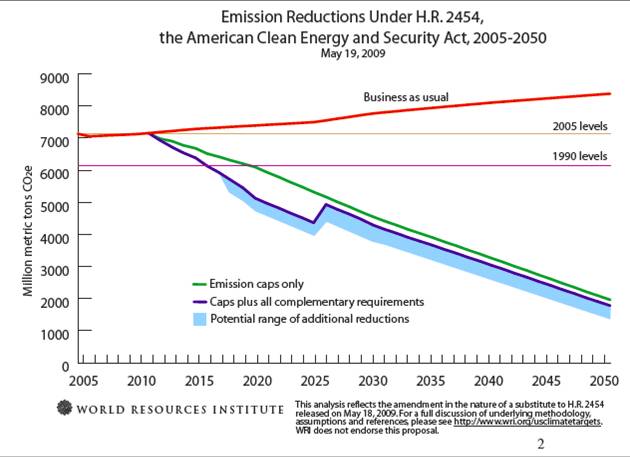 The American Clean Energy and Security (ACES) Act of 2009 has cleared one hurdle through passage by the House Energy and Commerce Committee. The bill now makes its way through at least two more House Committees before a floor vote will occur. The House leadership has set an aggressive time frame for passage, Speaker Pelosi has
Major Overhaul to House Climate Change Legislation
Representatives Waxman and Markey released their much anticipated re-write of their proposed cap and trade climate legislation earlier this week. Much speculation has been offered in the media that the bill had no chance of passing as it was originally structured, if it had any chance at all.
Well, there has apparently been a lot
OMB Critique of Proposed Endangerment Finding Causes Controversy
.jpg) As reported by the AP, "White House Memo Challenges Finding on Warming", an OMB document contains opinions that regulation of the greenhouse gases under the Clean Air Act could have dramatic impacts on the economy. The release of the OMB memo seems to have put the Obama Administration on the defensive.
As reported by the AP, "White House Memo Challenges Finding on Warming", an OMB document contains opinions that regulation of the greenhouse gases under the Clean Air Act could have dramatic impacts on the economy. The release of the OMB memo seems to have put the Obama Administration on the defensive.
Major news outlets including the N.Y Times
With the “Fuse Lit” Climate Legislation Bogs Down in Congress
.jpg) Democratic leaders of the US House Energy and Commerce Committee agreed to hold another hearing on climate change legislation on May 1. As discussed by commentators with the Environmental Markets Association, some Washington Insiders believe this announcement is a clear indication the Waxman-Markey Climate Legislation won’t make it.
Democratic leaders of the US House Energy and Commerce Committee agreed to hold another hearing on climate change legislation on May 1. As discussed by commentators with the Environmental Markets Association, some Washington Insiders believe this announcement is a clear indication the Waxman-Markey Climate Legislation won’t make it.
Republican have hammered home the unknown costs of the proposal
Footnote 29 of EPA’s Endangerment Finding

I am a bit behind in writing a post about EPA’s release of its endangerment finding. Earth Day seems like the perfect day to catch up and take advantage of the last few days to look at the reaction and likely consequences of EPA’s significant new action.
Background: In Massachusetts v. EPA decided in April of 2007, the Supreme Court held that greenhouse gases (GHGs) are pollutants that may be regulated under the Clean Air Act. But the Court did not go far enough to say EPA must regulate GHGs. At issue was Section 202 of the Clean Air Act which covers regulation of greenhouse gases from motor vehicles.
Under Section 202: The Administrator shall by regulation prescribe standards applicable to the emission of any air pollutant(s) from motor vehicles, “which in his judgment cause, or contribute to, air pollution which may reasonably be anticipated to endanger public health or welfare.”
The Court said EPA must conclude GHGs from motor vehicles endanger public health (i.e. "endangerment finding") before any regulation of emissions (tail pipe or fuel standards) from motor vehicles can occur. The Court remanded the Section 202 determination to EPA to make a legally defensible finding as to whether motor vehicle GHG emissions endanger public health.
Key Legal Issues Discussed in EPA’s Proposed Action: On April 17th, Administrator Jackson issued a proposed finding that vehicle emissions of GHGs do endanger public health. There is now a 60 day public comment period on the proposed action.
A key legal issue analyzed in the proposed action is whether Section 202 requires "actual harm" from a pollutant before it can be regulated. EPA’s proposed rule discusses the legislative history behind the language in Section 202 and concludes no finding of actual harm is necessary:
As the Committee further explained, the phrase “may reasonably be anticipated” points the Administrator in the direction of assessing current and future risks rather than waiting for proof of actual harm.
Also, EPA’s proposed action rejects the notion a demonstration is needed that controlling GHG emissions from U.S. autos would actually make a difference in addressing climate change. The EPA cited to language in the Supreme Court’s Massachusetts v. EPA :
Moreover, as the Supreme Court recognized, “[a]gencies, like legislatures, do not generally resolve massive problems in one fell regulatory swoop.”
Science and Findings in EPA’s Proposed Action: There is no new science behind the endangerment finding. Administrator Jackson relies on reports and conclusions from the U.S. Climate Change Science Program, the National Research Council, and the Intergovernmental Panel on Climate Change. She found these reports to provide more than sufficient support that GHG pose a "risk" to public health that should be addressed.
Here is how EPA has described its action on its web page and in supporting documentation:
The Administrator signed a proposal with two distinct findings regarding greenhouse gases under section 202(a) of the Clean Air Act:
1) The Administrator is proposing to find that the current and projected concentrations of the mix of six key greenhouse gases—carbon dioxide (CO2), methane (CH4), nitrous oxide (N2O), hydrofluorocarbons (HFCs), perfluorocarbons (PFCs), and sulfur hexafluoride (SF6)—in the atmosphere threaten the public health and welfare of current and future generations. This is referred to as the endangerment finding.
2) The Administrator is further proposing to find that the combined emissions of CO2, CH4, N2O, and HFCs from new motor vehicles and motor vehicle engines contribute to the atmospheric concentrations of these key greenhouse gases and hence to the threat of climate change. This is referred to as the cause or contribute finding.
This proposed action, as well as any final action in the future, would not itself impose any requirements on industry or other entities. An endangerment finding under one provision of the Clean Air Act would not by itself automatically trigger regulation under the entire Act
This last statement is very interesting.
Does "Endangerment" = "Regulation": Obviously the positive endangerment finding itself has major consequences. There is no doubt it sets EPA on a path to regulate GHGs under the Clean Air Act unless Congress passes a cap and trade bill as substitute regulation. While the path is set, the timing is in question. Does this proposed action by itself mean all other sources that emit GHGs (beyond just motor vehicles) are subject to regulation under the Clean Air Act?
The status of GHGs under the Clean Air Act is uncertain as it stands. EPA is currently taking comment on a separate action regarding regulation of GHGs under the Clean Air Act- Reconsideration of Former Administrator Johnson’s memo declaring GHG unregulated without further action.
Deseret Power was an appeal of a coal permit in which Sierra Club argued the permit was invalid because it didn’t include controls for GHGs. The Environmental Board of Review said it was an open question as to whether GHG are considered "regulated pollutants" under the Clean Air Act. Sierra Club pointed to existing requirements to monitor CO2 emissions as evidence of regulation. The EAB said EPA had discretion to decide whether monitoring was enough to amount to regulation.
In response to the EAB, Johnson, in one of his last acts before leaving office, tried to fill the void by issuing an interpretive memo determining CO2 was not a regulated pollutant due to the monitoring provisions. Administrator Jackson is currently reviewing the Johnson memo following the Sierra Club petition.
THIS IS A HUGE ISSUE…If GHGs are regulated pollutants, then no additional legislation, rulemaking or action is necessary. EPA could not issue permits to sources of GHGs without considering controls for those emissions.
Footnote 29 of the Endangerment Finding: So does EPA’s proposed endangerment finding amount to "regulation" of GHGs under the Clean Air Act? Buried in footnote 29 on page 106 of the Proposed Rule is to me one of the most significant consequences flowing from a positive endangerment finding- does the finding amount to regulation. Here is what footnote 29 says:
At this time, a final positive endangerment finding would not make the air pollutant found to cause or contribute to air pollution that endangers a regulated pollutant under the CAA’s Prevention of Significant Deterioration (PSD) program. See memorandum entitled “EPA’s Interpretation of Regulations that Determine Pollutants Covered By Federal Prevention of Significant Deterioration (PSD) Permit Program” (Dec. 18, 2008). EPA is reconsidering this memorandum and
will be seeking public comment on the issues raised in it. That proceeding, not this rulemaking, would be the appropriate venue for submitting comments on the issue of whether a final, positive endangerment finding under section 202(a) of the Act should trigger the PSD program, and the implications of the definition of air pollutant in that endangerment finding on the PSD program.
EPA’s footnote is confusing. The issue in the reconsideration on the Johnson memo really should be limited to whether monitoring is sufficient to constitute "regulation" under the Act. An endangerment finding would be a new action by EPA that will take place after Deseret Power was issued, after the Johnson Memo was written and after EPA granted the reconsideration of the Sierra Club petition.
Perhaps the final action on the review of the Johnson memo will make this debate moot. It certainly will if that action is to say GHG’s are a regulated pollutant based upon monitoring requirements alone. However, anything other than that outcome will allow the endangerment finding to be new grounds to argue GHGs are regulated under the Act. In a prior post I discussed what a horrible outcome that would be as a regulatory approach.
Final Comment: Once again, to those questioning the merits of a Cap and Trade market mechanism for controlling GHGs- consider the alternative. Like it or not EPA is on a path to regulate GHGs. Due to the Supreme Court’s holding in Massachusetts v EPA, there is no getting off that path or turning around.
(see the extended entry for discussion of the reaction to EPA’s action)Continue Reading Footnote 29 of EPA’s Endangerment Finding
House Begins the Debate on Cap and Trade
 House Energy and Commerce Committee Chairman Henry Waxman (D-Calif.) and Chairman of the Energy and Environment Subcommittee Edward J. Markey (D-Mass.) introduced the “The American Clean Energy and Security Act” as the opening salvo in a contentious and complex debate over a greenhouse cap and trade program. The bill links two major and independently controversial